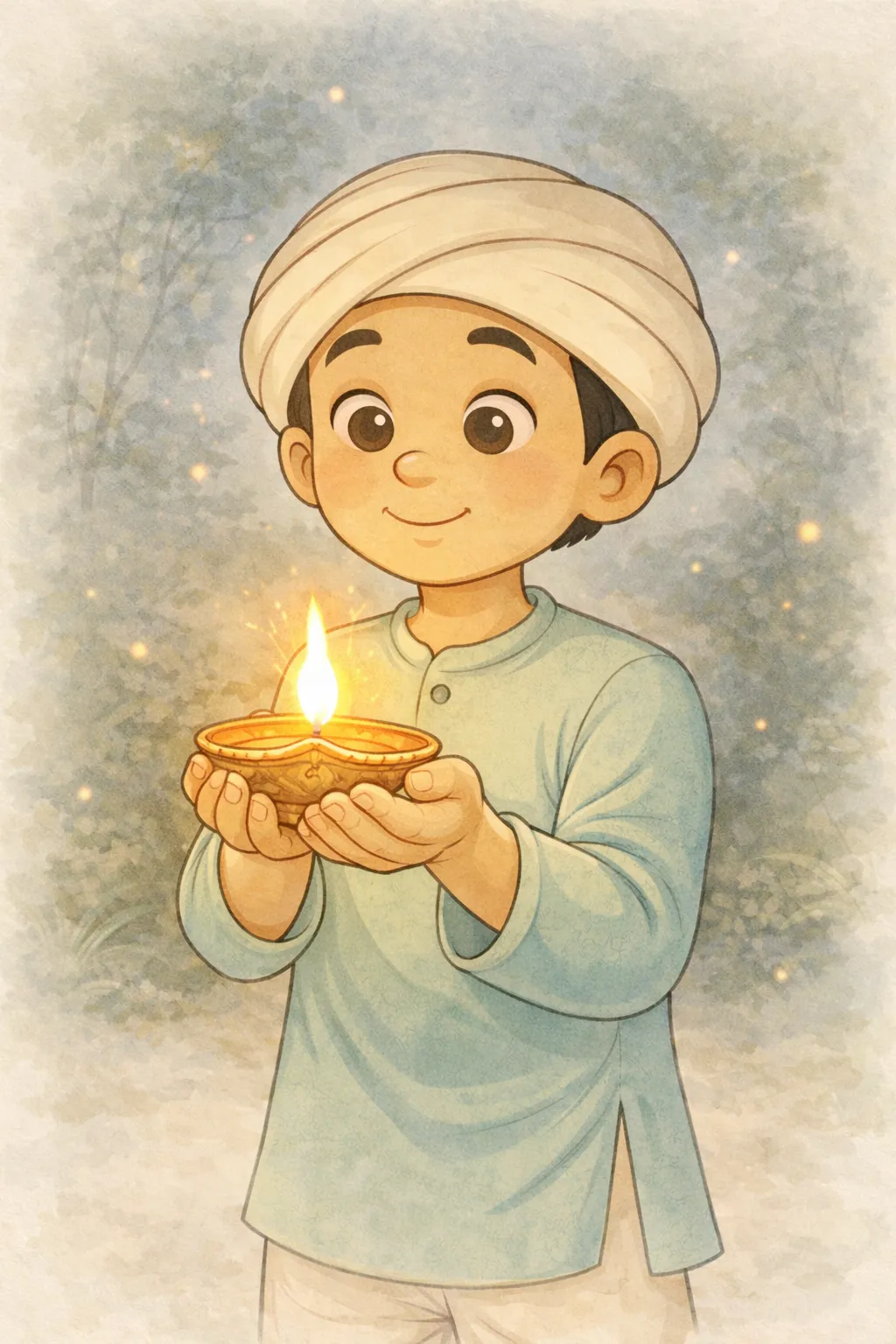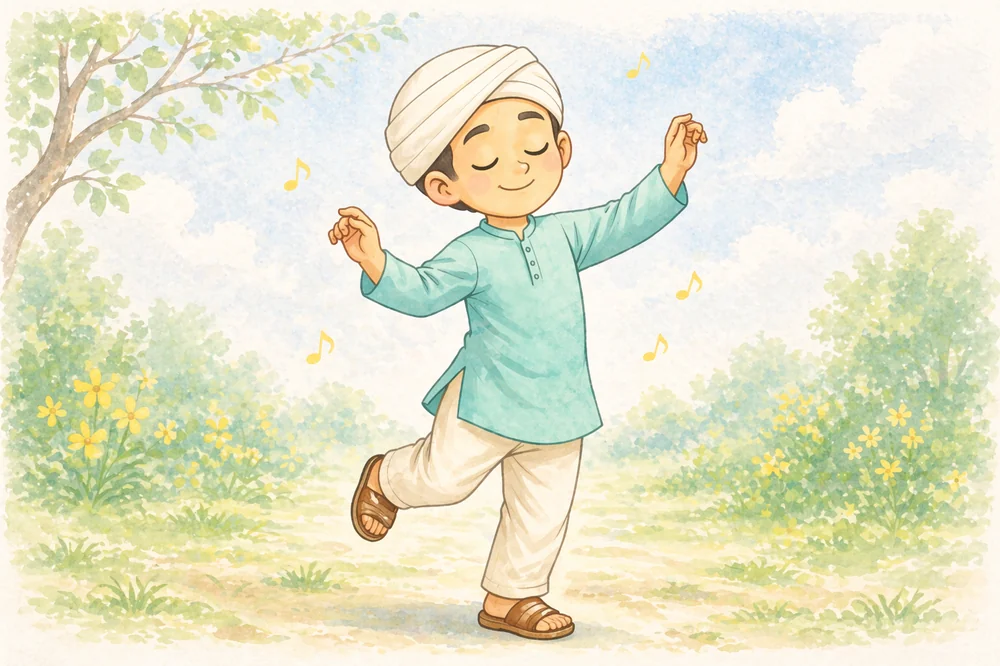
धीरे-धीरे रे मना, धीरे सब कुछ होय।
माली सींचे सौ घड़ा, ऋतु आए फल होय।

Kabir ke Dohe · For Children

Kabir Dohas for Children — Simple Meanings and Life Lessons

The 10 most important Kabir dohas for children — with original Hindi, simple English meanings, life lessons, real-life examples, and an age guide.

Kabir Das wrote in plain Hindi so everyone could understand. His dohas give children a compass for life — for patience, honesty, kindness, and humility. This page is for parents, teachers, and anyone looking for Kabir dohas explained for kids.

Who was Kabir Das?

600 years old — and still the clearest voice in the room

Kabir Das was a 15th-century poet-saint from Varanasi. He didn't write for scholars. He wrote for ordinary people — weavers, farmers, parents, children — in the everyday Hindi they spoke.

His dohas (two-line poems) are among the most quoted wisdom in India. Each one carries a complete life lesson. Not vague philosophy — specific, actionable, and vivid.

Children who grow up knowing even five Kabir dohas have a vocabulary for the most important moments in life: when to act, how to speak, how to handle failure, how to treat others.

At Kabir for Kids, we simplify the archaic words slightly — while preserving every ounce of meaning. The wisdom stays. The language becomes accessible to a 6-year-old.

Our approach to simplification →
Kabir Das · 15th century
बोली एक अनमोल है,
सर के सिर ठहराय।
हिये तराजू तोल के,
तब मुख बाहर आय।
"Words are a priceless gem — weigh them on the scales of your heart before letting them out of your mouth."

This is one of the 10 dohas explained below — with a sing-along video for children ▶

The essential list

Top 10 Kabir Dohas for Children — with Meaning

Each doha includes the original Hindi, Hinglish pronunciation, simple meaning, lesson for children, a real-life example, and an age guide.

Doha 01
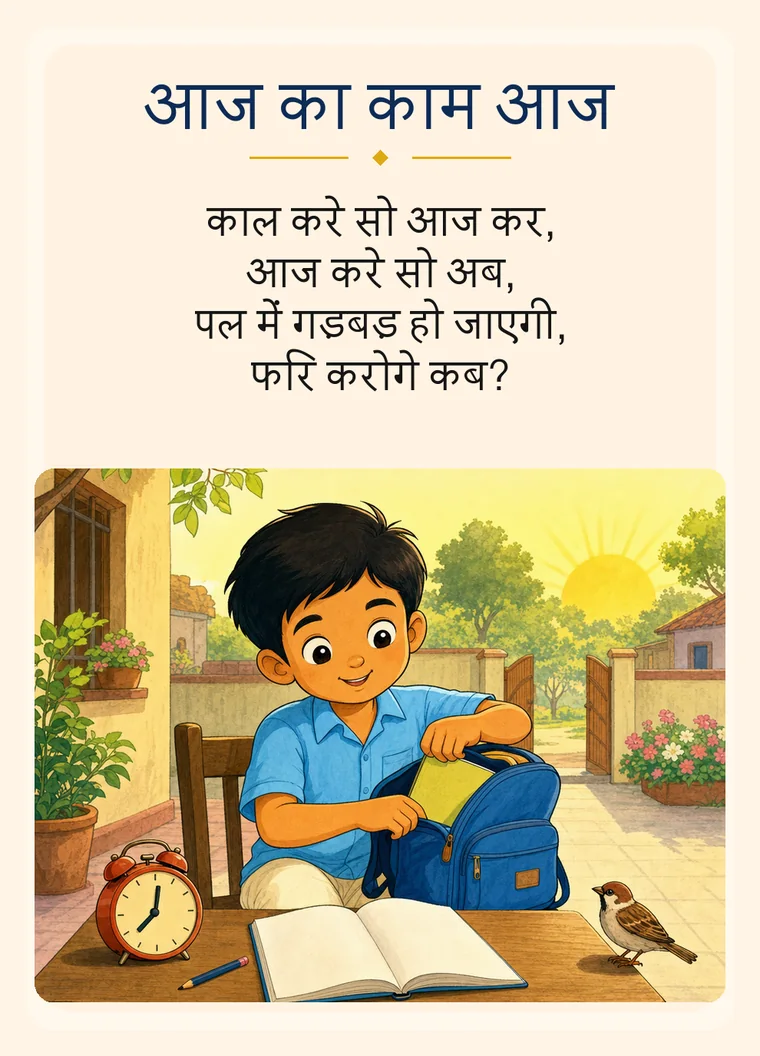
काल करे सो आज कर, आज करे सो अब।
पल में प्रलय होगी, बहुरि करेगा कब।
Kal kare so aaj kar, aaj kare so ab.
Pal mein pralay hogi, bahuri karega kab.
Time & Action Age 5+
Simple Meaning
What you plan to do tomorrow — do today. What you plan to do today — do right now. Life is short and uncertain. Don't wait.
Lesson for Children
If you want to say sorry to a friend, say it now. If you want to start your homework, start now. Don't keep saying "I'll do it later."
Real-Life Example
A child keeps saying they'll tidy their room "after this game." Kabir asks: what are you waiting for? The room won't tidy itself and the moment will keep moving.
✦   Don't delay — whatever needs doing, start right now
Doha 02
बोली एक अनमोल है, सर के सिर ठहराय।
हिये तराजू तोल के, तब मुख बाहर आय।
Boli ek anmol hai, sar ke sir thaharaay.
Hiye taraaju tol ke, tab mukh baahar aay.
Speak Kindly Age 5+ ▶ Watch Video
Simple Meaning
Words are a priceless gem, valued more than gold. Weigh them on the scales of your heart before letting them out of your mouth.
Lesson for Children
Think before you speak. Words can't be taken back. One unkind word can hurt a friend for days. One kind word can lift them for weeks.
Real-Life Example
A child says something mean in anger and then regrets it. Kabir's lesson: the gem (word) once thrown cannot be caught. Pause before speaking.
✦   Think before you speak — words are powerful and permanent
Doha 03
धीरे-धीरे रे मना, धीरे सब कुछ होय।
माली सींचे सौ घड़ा, ऋतु आए फल होय।
Dheere dheere re mana, dheere sab kuch hoy.
Maali seenche sau ghada, ritu aaye phal hoy.
Patience Age 5+
Simple Meaning
Be patient, O mind — everything happens in its own time. Even if the gardener waters a hundred pots, fruit comes only when the season arrives.
Lesson for Children
You can't rush learning to read or learning to cycle. Keep trying, keep practising — when the right time comes, you will be ready. Effort + patience = result.
Real-Life Example
A child is frustrated they can't draw as well as their friend. Kabir reminds them: the gardener still waters even when there's no fruit yet. Keep going.
✦   Be patient — good things grow slowly, with steady effort
Doha 04
बड़ा हुआ तो क्या हुआ, जैसे पेड़ खजूर।
पंथी को छाया नहीं, फल लागे अति दूर।
Bada hua to kya hua, jaise ped khajoor.
Panthi ko chhaya nahin, phal laage ati door.
Character Age 6+
Simple Meaning
What is the use of being tall like a date palm — if the tired traveller gets no shade and the fruit is too high to reach? Being big without being useful means nothing.
Lesson for Children
Being the oldest or the strongest doesn't matter if you don't help others. Real greatness is about being useful and kind — not about your age, height, or rank.
Real-Life Example
An older sibling brags about being big but refuses to help the younger one. Kabir asks: are you a date palm — tall but unreachable? What good is your size?
✦   Real greatness means being useful to others, not just being big
Doha 05
निंदक नियरे राखिए, आँगन कुटी छवाय।
बिन पानी साबुन बिना, निर्मल करे सुभाय।
Nindak niyare rakhiye, aangan kuti chhavay.
Bin paani sabun bina, nirmal kare subhaay.
Humility Age 7+
Simple Meaning
Keep your critic close — build them a hut in your courtyard. Without soap or water, they clean your character by honestly pointing out your faults.
Lesson for Children
When someone points out a mistake, don't get angry or defensive. Say thank you. They are helping you become better — that's what a real friend does.
Real-Life Example
A teacher marks your work with corrections. A friend tells you your answer was wrong. Instead of sulking, treat this as a gift — they saved you from staying wrong.
✦   Welcome honest feedback — it's the fastest way to grow
Doha 06
जो तोको काँटा बुवै, ताहि बोय तू फूल।
तोको फूल को फूल है, वाको है तिरशूल।
Jo toko kaanta buvai, taahi boy tu phool.
Toko phool ko phool hai, waako hai tirshool.
Forgiveness Age 6+
Simple Meaning
If someone plants thorns in your path, plant flowers in theirs. For you, the flower remains a flower — but for them, the thorn becomes a trident (their own cruelty hurts them back).
Lesson for Children
When someone is unkind to you, respond with kindness — not revenge. This doesn't mean you are weak. It means you are stronger than the situation.
Real-Life Example
A classmate says something mean about your drawing. Instead of saying something mean back, you compliment their work. You go home feeling good — they don't.
✦   Respond to unkindness with kindness — it is the stronger choice
Doha 07
गुरु गोविंद दोनों खड़े, काके लागूं पाय।
बलिहारी गुरु आपनो, गोविंद दियो बताय।
Guru Govind dono khade, kaake laagoon paay.
Balihaari guru aapno, Govind diyo bataay.
Respect Age 5+
Simple Meaning
Both God and my Guru (teacher) stand before me — whose feet do I touch first? I bow to my Guru first, because it was the Guru who showed me the path to God.
Lesson for Children
Your teacher gives you something no one else can — the ability to learn, to think, and to grow. Respect and gratitude for teachers is one of the highest values.
Real-Life Example
A child who learns to read can go anywhere in life. The teacher who taught them that — before anyone else. That is what Kabir is saying.
✦   Respect your teachers — they open the door to everything else
Doha 08
साईं इतना दीजिए, जा में कुटुम समाय।
मैं भी भूखा न रहूँ, साधु न भूखा जाय।
Saain itna dijiye, ja mein kutum samaay.
Main bhi bhookha na rahun, saadhu na bhooka jaay.
Contentment Age 7+
Simple Meaning
O God, give me just enough — enough for my family to eat, so that I am not hungry, and anyone who comes to my door is not turned away hungry either.
Lesson for Children
Kabir doesn't ask for riches or a palace — just enough. The lesson: wanting enough is wisdom. Wanting more and more brings restlessness, never peace.
Real-Life Example
A child always wants the newest toy, the biggest portion, the latest phone. Kabir asks: do you already have enough? Could you share some of what you have?
✦   Be content with enough — and share what you have
Doha 09
दुःख में सुमिरन सब करे, सुख में करे न कोय।
जो सुख में सुमिरन करे, तो दुःख काहे होय।
Dukh mein sumiran sab kare, sukh mein kare na koy.
Jo sukh mein sumiran kare, to dukh kahe hoy.
Gratitude Age 7+
Simple Meaning
Everyone remembers God when they are in trouble, but no one remembers when they are happy. If you remembered even in happiness, why would sorrow come?
Lesson for Children
Be grateful when things are good — not only when something goes wrong. Gratitude every day, not only when you need something. Notice the good before it's gone.
Real-Life Example
A child only says thank you when they want something. Kabir's lesson: thank someone today for something they did last week. Gratitude grows when practised daily.
✦   Be grateful every day — not only when things go wrong
Doha 10
माटी कहे कुम्हार से, तू क्या रौंदे मोय।
एक दिन ऐसा आएगा, मैं रौंदूँगी तोय।
Maati kahe kumhaar se, tu kya raunday moy.
Ek din aisa aayega, main raundoongi toy.
Ego & Humility Age 8+
Simple Meaning
The clay says to the potter: "Why do you trample me?" A day will come when I will trample you. No one is above nature. Ego has no ground to stand on.
Lesson for Children
Don't look down on anyone — not a classmate who isn't as fast, not a child who isn't as clever. Everyone deserves dignity. No one is above anyone else.
Real-Life Example
A child laughs at another for making a mistake. Kabir's lesson: the clay has its own dignity. Your turn to make a mistake will come. Treat everyone with respect.
✦   Don't look down on anyone — every person deserves dignity
Explore 150+ dohas in the full library →
The case for Kabir

Why Kabir's Dohas are Good for Children

Not just because they are old. Because they work — in ways modern content often doesn't.

They are specific, not vague

Kabir doesn't say "be good." He says: the clay will eventually trample the potter. Don't delay — life is as long as one moment. Words are a gem — weigh them before you speak. Specific images stick. Abstract advice doesn't.

They are designed to be remembered

Dohas are two-line rhyming couplets. They scan, they rhythm, they land. A child who hears "Kal kare so aaj kar" three times will carry it for life — the way they carry nursery rhymes. The form is the memory device.

They are rooted in India

The date palm, the gardener, the clay and potter, the courtyard — these are Indian images, Indian life. Children growing up in India connect to them instantly. It's wisdom from their own soil, not imported values in translation.

They address real moments, not theoretical ones

Procrastination. Impatience. Unkind words. Ego. Ingratitude. These are not abstract problems — they are things children face every day, by age 6. Kabir's dohas give children a language for moments they haven't yet had words for.

Little Kabir sitting under a tree, reading a book with a squirrel companion
How a doha stays

Two lines. One image. A small idea that grows across years.

A guide for families

How Parents Can Use Kabir Dohas at Home

Dohas work best when they arrive naturally — as shared moments, not scheduled lessons.

1

Watch the story before explaining the words

Each Kabir for Kids animated story builds context for one doha. The child experiences the lesson through the character before hearing the words. The doha then clicks into place — "oh, that's what Kabir meant." Start with the story, not the couplet.

2

Use it in the moment, not as a lecture

When a child is rushing, delaying, or being unkind — bring the doha in lightly. "Remember what Kabir said about the date palm?" or "Boli ek anmol hai — what do you think before we say that?" The doha becomes a nudge, not a scolding.

3

Sing it rather than recite it

The Kabir for Kids Sing Along videos turn each doha into a simple melody. Research suggests children retain sung content significantly better than spoken content. Put it on during the car ride or morning routine — you'll be surprised how quickly they pick it up without trying.

4

Ask "what do you think it means?" first

Don't rush to explain. Ask the child what they think the doha means. A 7-year-old will often find the meaning themselves with a few gentle questions. This builds ownership — they remember it as their own insight, not something they were told.

5

Pick one doha for a month, not ten in a week

Depth over breadth. One doha truly understood and applied — that a child brings up on their own, uses in conversation, remembers a year later — is worth more than ten dohas memorised for a test. Let one wisdom land fully before moving to the next.

Watch Kabir videos for kids →
In the classroom

How Teachers Can Use Kabir Dohas in School

Kabir dohas are natural anchors for value education, Hindi language teaching, and morning assembly. Here's how to make them land.

One doha per assembly — with a one-line explanation

Display the Hindi text on screen. Read it aloud together. Then offer one clear sentence: "Kabir is saying — don't delay, whatever needs doing, start now." Keep it short. The doha carries itself.

Discussion prompt: "When did this happen to you?"

After introducing a doha, ask students to share a time when the lesson applied to their own life. Personal connection is the strongest form of retention. Even a 6-year-old will have a story for "I said something I wished I hadn't."

Sing Along videos as a classroom opener

A 2–3 minute Sing Along video before a Hindi or value education class settles the room and introduces the session's theme through melody. Children who have sung the doha are already engaged before the lesson begins.

Pair with creative writing: "Kabir would say..."

Give students a situation — someone being bullied, someone procrastinating, someone being rude — and ask: which Kabir doha fits this moment? What would Kabir say? This builds both analytical thinking and moral reasoning.

Kabir for Kids Workshops

Bring Kabir into your school

We run in-person storytelling and doha workshops for students and teachers across India. Each session uses one Kabir doha as its anchor — explored through story, song, discussion, and activity.

8+
Schools
1600+
Students
5
Cities
View Workshop Programmes →
For school projects & exams

Top 10 Kabir Dohas for Students — Quick Reference

These are the 10 dohas most commonly asked about in school contexts — Hindi class, value education, morning assembly, and project work.

1

काल करे सो आज कर

Don't delay. Do it now. Most commonly cited in Hindi textbooks for Classes 3–6.

Time & Action
2

बोली एक अनमोल है

Think before you speak. Words cannot be taken back once spoken.

Speak Kindly
3

धीरे-धीरे रे मना

Be patient. Results come in their own time. Steady effort is the answer.

Patience
4

बड़ा हुआ तो क्या हुआ

Being big or senior means nothing without being useful and kind to others.

Character
5

निंदक नियरे राखिए

Keep your honest critic close. They help you grow without soap or water.

Humility
6

जो तोको काँटा बुवै

If someone plants thorns in your path, plant flowers in theirs.

Forgiveness
7

गुरु गोविंद दोनों खड़े

Bow to your Guru first — the teacher showed you the path to everything.

Respect
8

साईं इतना दीजिए

Ask for just enough — for your family, and a guest. Contentment is wisdom.

Contentment
9

दुःख में सुमिरन सब करे

Be grateful when things are good — not only when things go wrong.

Gratitude
10

माटी कहे कुम्हार से

Even clay has dignity. Don't look down on anyone — your turn will come.

Ego & Humility
Search 150+ dohas by theme →
Common questions

Frequently Asked Questions about Kabir Dohas for Children

The best Kabir dohas for children are ones that connect to everyday situations they face: "Kal kare so aaj kar" (don't delay), "Boli ek anmol hai" (speak kindly), "Dheere dheere re mana" (be patient), and "Bada hua to kya hua" (being big without being helpful means nothing). These dohas use simple images — a date palm tree, a gardener, words as precious jewels — that children can picture and remember.
Children as young as 4–5 can absorb the emotional meaning of Kabir dohas through stories and songs, even if they cannot fully articulate the meaning. Children aged 7–8 can understand simplified explanations and connect them to real situations. The key is to use the doha in context — not as a recitation exercise, but as a living piece of wisdom that arrives naturally in a moment.
The best Kabir doha for teaching patience is "Dheere dheere re mana, dheere sab kuch hoy. Maali seenche sau ghada, ritu aaye phal hoy." It means: be patient, O mind — everything happens in its own time. Even if the gardener waters a hundred pots, fruit comes only when the season arrives. This is perfect for children frustrated with learning — reading, riding a bicycle, or waiting for something they want.
Yes. Several Kabir dohas appear in CBSE and state board Hindi textbooks from Class 3 onwards. "Kal kare so aaj kar", "Nindak niyare rakhiye", and "Dheere dheere re mana" are among the most commonly included. However, textbooks often present them with archaic language and minimal explanation. Kabir for Kids simplifies the language while preserving the meaning, making them accessible to children from age 4.
For a school assembly, the most impactful Kabir dohas are: "Kal kare so aaj kar" (action, discipline), "Guru Govind dono khade" (respect for teachers), and "Boli ek anmol hai" (speak kindly). All three are short, memorable, and carry a clear message that works across age groups. Pair the doha with one clear sentence of explanation for maximum impact.
The best approach is through stories first, words second. Show a situation where the lesson plays out — a child who delays homework and misses playtime (for "Kal kare so aaj kar"), or a child who says something unkind and sees how it hurts (for "Boli ek anmol hai"). Once the child has felt the lesson emotionally, the doha becomes a shorthand for something they already understand. Kabir for Kids animated stories follow this exact approach.
Kabir Das is credited with hundreds of dohas, though the exact number is debated — many were passed down orally for generations before being written down. Collections vary between 200 and 800 dohas. The Kabir for Kids library currently includes 150+ dohas, all simplified and explained for children aged 4–10.
Yes — Kabir dohas are exceptionally well-suited to value education because each one is a self-contained lesson on a single theme: honesty, patience, humility, gratitude, kindness, or contentment. They are short enough to memorise, rich enough to discuss, and rooted in Indian culture. Kabir for Kids runs in-person workshops in schools specifically designed around Kabir dohas for value education.

The full Kabir doha library — free, searchable, explained

150+ Kabir dohas. Search by keyword or browse by theme — patience, honesty, humility, gratitude, kindness. Every doha with original Hindi, simplified version, and meaning in English.

Open Doha Library Watch Kabir Videos for Kids